
Small businesses often have to make marketing decisions around practical constraints: who will manage enquiries, which channels already bring customers, and how much time the team can spend maintaining them. Adding another platform does not solve a problem if the business cannot follow up on the leads it generates.
The useful starting point is therefore not the number of channels available, but the point at which the customer journey needs attention. A local contractor may need stronger visibility in Google Maps. An online store may need better email follow-up after a purchase. A B2B company may need clearer lead tracking because enquiries take weeks or months to turn into contracts.
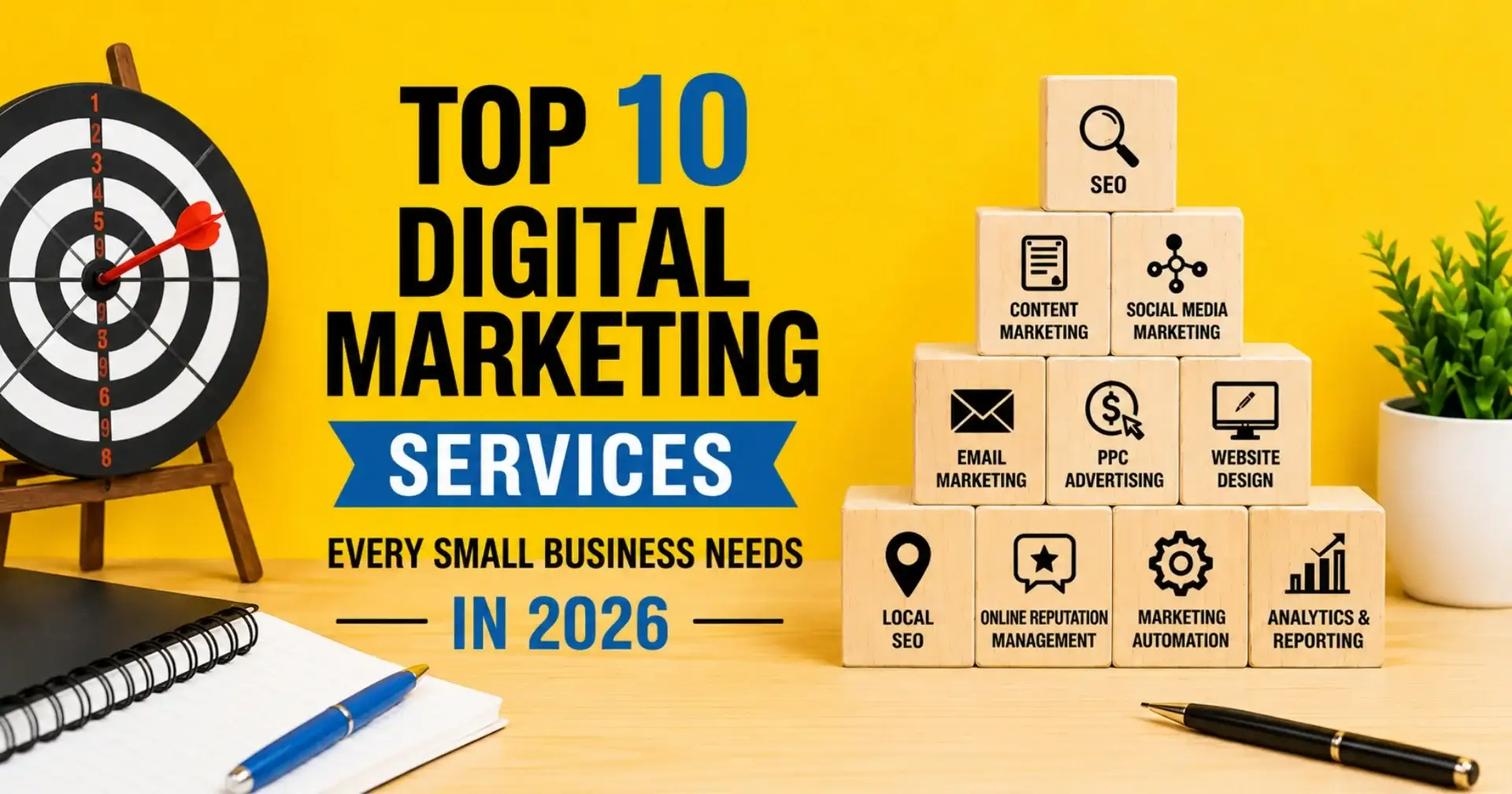
The services below cover those different parts of the customer journey, from local search and paid advertising to messaging, lead generation, automation, and performance tracking. The right combination depends on how a business attracts and converts its customers.

Get a Quote

FAQ

Contact Us
What Are Digital Marketing Services?
Digital Marketing Services cover the online activities a business uses to attract potential customers, generate enquiries, support sales, and stay connected with existing clients. Depending on the company, that may include search engine optimization, paid search, social media, email, messaging, automation, lead generation, or analytics.
Unlike traditional print channels, modern digital execution relies on ongoing campaign data, specific audience targeting, and multi-channel performance tracking.
The Right Mix Depends on How Your Business Gets Customers
Every small business operates on a distinct commercial cycle. A local service company often starts with a well-maintained Google Business Profile and search advertising. An online retailer usually allocates more resources to paid social, email automation, product content, and conversion tracking. A B2B company with a longer sales cycle requires organic search visibility, LinkedIn content, lead nurturing, and CRM integration.
Before choosing another platform, find the point where potential customers are currently dropping out:
Demand Generation -> Initial Conversion -> Lead Follow-up -> Measurement
Start by finding where the sales process is losing potential customers. If potential clients cannot locate your company, visibility is the primary issue. If site visitors leave without reaching out, conversion mechanisms need work. If enquiries drop off after initial contact, follow-up procedures require attention. If sales occur but campaign performance remains unclear, attribution requires setup.
1. Local Search Optimization and Google Business Profile Management
For companies serving a specific geographic area, maintaining a Google Business Profile is a logical starting point. When nearby users search for immediate assistance, local map listings usually form their first impression of available options.
Ranking Factors in Local Search
Google’s documentation identifies three primary factors for local search results:
- Relevance: How accurately a business profile matches the intent behind a user’s search query.
- Distance: How far the business is from the searcher or the location used in the search.
- Prominence: How well-known a business is. Google states that prominence can be informed by information gathered from links, articles, directory citations, and reviews.
Complete business details, accurate operating hours, representative photos, and genuine customer reviews give prospective clients more useful information when evaluating their choices.
2. Generative Engine Optimization (GEO) and Modern SEO
People no longer use search engines in quite the same way. Google’s AI Overviews now appear for some searches, and potential customers may also use conversational AI when comparing companies or looking for answers about a service.
For businesses, the fundamentals haven’t changed as dramatically as the terminology suggests. A search engine still needs to access the site, understand its pages, and determine what each page is about. That means keeping important service information in readable page content, linking related pages properly, and using structured data only where it accurately describes the information displayed to visitors.
The content itself deserves equal attention. A service page should explain what the company actually provides, who the service is for, where it is available, and what a customer should expect. Project examples, specific service details and useful answers to customer questions give both visitors and search systems more context to work with.
3. Search Engine Advertising and Organic Performance Monitoring
Google Ads (Pay-Per-Click Advertising) is useful when a business wants to appear for searches that already have commercial intent. A company selling a specific service, for example, can build campaigns around the terms people use when they are ready to compare providers or request a quotation.
Unlike social media advertising that interrupts casual browsing, search ads capture existing demand at the moment of intent.
What a Search Campaign Needs
- Targeting: High-intent search terms while filtering out generic informational queries.
- Negative Keywords: Building negative keyword lists to prevent ad spend on irrelevant searches.
- Search-Term Audits: Conducting routine audits to identify real user search queries that warrant dedicated ad copy or custom landing pages.
- Conversion Tracking: Establishing tracking for form submissions, phone calls, and consultation requests.
- Landing Pages: Directing ad traffic to dedicated, fast-loading landing pages focused on a single call to action.
Organic Search Console Integration
Keep organic performance tracking distinct from paid campaign management. Setting up Google Search Console gives your business a direct view of organic impressions, search queries, indexing issues, and click-through rates. Search Console complements paid advertising data by showing organic visibility and search behaviour separately from paid campaign performance.
4. Conversational WhatsApp Campaigns and Privacy Consent
Direct messaging platforms offer businesses an unmediated channel for communicating with prospects and existing clients. A structured WhatsApp campaign strategy allows companies to send time-sensitive updates, booking confirmations, and service promotions.
Managing high volumes of messages manually can strain small teams. Using dedicated WhatsApp marketing software allows a company to run automated follow-up sequences, send service catalogs, and handle routine inquiries within the chat app.
Automation must operate within applicable privacy, consent, and messaging requirements:
- Consent and Records: Use an appropriate consent process and maintain records that allow the business to demonstrate how subscribers agreed to receive marketing communications.
- Transparency: Explain what subscribers will receive, provide a clear way to opt out, and handle customer data according to applicable privacy requirements.
5. Automated AI Calling and Voice Intake Protocols
AI calling becomes particularly useful when a small team receives more inbound inquiries than it can handle during peak hours. An AI calling agent can answer routine questions, collect basic contact details, screen prospective leads, and route urgent matters to available staff.
A reliable deployment needs clear operational guardrails:
- Caller Disclosure: Clearly inform callers when they are interacting with an automated system and provide a direct path to reach a human representative.
- Human Transfer Triggers: Unclear caller requests, account cancellations, pricing exceptions, complex technical questions, and upset customers must transfer immediately to human staff.
- Restricted Topics: Automated systems should not independently handle sensitive medical details, direct payment processing, or legally binding agreements without appropriate controls and human oversight.
6. Targeted Email Marketing and Automation
Changes in social media organic reach are affected by algorithm updates. The mailing list of an email subscriber will help the company maintain a direct line of communication with individuals who specifically request updates about the brand.
The use of specialized mass Email Marketing programs enables the firm to categorize its subscribers according to their purchasing behavior, preferences for certain services, or level of engagement. The distribution of onboarding documents or reminders of certain services becomes automated.
7. Guest Post Outreach, Digital PR, and Contextual Links
Editorial coverage can introduce a business to a new audience, while relevant external links can help search engines understand relationships between websites, topics, and sources.
Relevance should be the starting point. Executing targeted guest post outreach or digital PR campaigns on unrelated websites offers little strategic value. A more effective approach involves contributing genuine industry commentary, local business updates, founder insights, or detailed case studies to regional or trade publications read by your target market.
8. Professional Lead Generation and Conversion Optimization
Website visitors need an obvious next step if you want that traffic to produce enquiries. A professional lead generation service brings together your traffic sources, contact options, messaging, and CRM so prospects can move into the sales process more easily.
Enquiry forms should collect the details the sales team needs to assess a lead, such as the service required, location, project timeline, or estimated budget. Keep the form focused, though. Asking for information that has no bearing on the next stage can discourage people from completing it, especially on mobile.
Conversion Accessibility
Conversion surfaces should be designed to remain usable for as many potential clients as possible. Well-designed landing pages incorporate accessible design choices: legible typography contrast, screen-reader-compatible forms, clear visual focus states, video captioning, and responsive layouts that function smoothly on mobile devices.
9. Short-Form Video and Social Content
Short-form videos give local and professional service businesses a straightforward way to demonstrate their operational work. Publishing concise video clips on platforms like Instagram Reels, YouTube Shorts, or LinkedIn provides prospective clients with visual context before they make initial contact.
High production values are rarely necessary. Concise video walkthroughs, plain-language answers to common customer questions, and brief project overviews recorded on a smartphone give prospective clients a clear view of the people, processes, and expertise behind your service.
10. Marketing Analytics and Conversion Attribution
Marketing budgets are hard to allocate effectively when a company cannot determine which channels generated its sales enquiries. Professional data analytics implementations link website traffic, paid ad clicks, lead form submissions, and inbound phone calls directly to CRM sales records.
Connecting Metrics to Commercial Outcomes
A click or form submission does not necessarily mean that a sale has taken place. There can be several steps between the first interaction and a completed deal.
For example, a business may track a customer’s journey from an impression to a click, enquiry, qualified lead, proposal, and finally a sale.
If the value of completed sales is available, it can also be included in the analysis. This makes it easier to see which marketing activity is actually contributing to revenue.
Offline Conversion Tracking & Attribution Limits
For businesses that close sales by phone, in person, or through offline quotations, CRM or offline conversion tracking can help connect the original marketing interaction with an eventual offline transaction.
No tracking configuration captures every customer interaction perfectly. Reporting should reconcile website analytics, advertising platforms, CRM records, and offline sales data where possible, treating attribution as a practical decision-making tool rather than a perfect reconstruction of every customer path.
How to Judge Whether a Marketing Service Is Working
Evaluating a digital marketing service requires looking at the commercial outcome it is designed to influence. Different channels operate on different time horizons:
- Local SEO and Google Business Profile: Evaluated via inbound call volume, map direction requests, local contact form fills, and booked local jobs.
- Paid Search Advertising: Evaluated by cost per qualified lead, conversion rate, and net revenue generated against ad spend.
- Email & WhatsApp Automation: Measured through response rates, repeat appointments, reduced call drop-offs, and customer retention.
- Content & Technical SEO: Evaluated by organic traffic growth to key service pages, keyword positioning for commercial terms, and assisted conversions over a multi-month period.
A B2B firm may require several months for an enquiry to become a closed contract, whereas a local service business may close a job within 48 hours. Campaign reporting should reflect those operational realities.
How TreeMultisoft Supports Small Business Growth
Tree Multisoft coordinates these core digital channels as an interconnected strategy rather than managing search, paid media, messaging, and analytics as isolated tasks.
Depending on your current operational goals, our team assists with campaign execution, WhatsApp messaging setup, AI call intake routing, local search optimization, and lead tracking.
Practical Execution
For a local service business, the work may begin with checking business details across directories, reviewing map listings, and connecting call tracking with incoming enquiries. B2B projects usually involve different priorities, such as improving site structure, strengthening service pages, refining enquiry forms, and connecting leads with the CRM.
One issue we often encounter is incomplete tracking of phone and form enquiries. When those gaps are addressed, business owners have a clearer picture of which marketing activities are actually contributing to recorded sales.
So Which Service Should You Start With?
You do not need to take on all ten services at the same time. Look at where the current customer journey is falling short and address that area first.
- Having trouble being found locally? Start with your Google Business Profile and local search presence.
- Getting website visitors but few enquiries? Review your landing pages, forms, calls to action, and accessibility.
- Receiving leads but struggling with follow-up? Consider email or WhatsApp automation.
- Getting enquiries without knowing which channels generate sales? Set up event tracking, Google Search Console, and CRM-based attribution.
Get a Quote
FAQ
Contact Us
FAQs
How much should a small business spend on digital marketing services?
There is no universal percentage or fixed spend requirement. Budget allocation depends on target profit margins, customer acquisition economics, local market competition, and operational intake capacity. A practical approach is starting with a focused spend on a high-intent channel—such as search ads or local optimization—and expanding investment as attribution data confirms positive returns.
Does a small business need to invest in all 10 digital marketing services at once?
No. Not every business needs all ten. The appropriate mix depends on how customers find your business, the length of your sales cycle, available budget, and your team's capacity to process incoming inquiries. Local service companies often start with local search, search ads, and review management, while e-commerce sites focus heavily on product SEO, paid social, email automation, and conversion metrics.
Which digital marketing services deliver the fastest initial results?
Google Ads can begin generating enquiries shortly after campaigns go live when there is existing search demand and the campaign is properly configured. A complete Google Business Profile also allows local companies to capture existing nearby demand quickly. Organic SEO, content publishing, and email list development naturally require more time to mature.
Why use WhatsApp marketing software instead of standard SMS?
WhatsApp supports interactive communication, rich media, custom response buttons, automated chat routing, and structured service catalogs. Dedicated software lets small teams manage these interactions systematically while maintaining customer data privacy and consent logs.
How does AI calling integrate into daily business operations?
AI voice agents handle routine inquiries, collect initial client information, and screen incoming leads automatically. This operational fallback reduces missed calls after hours while keeping internal staff focused on high-priority client work.
How does Generative Engine Optimization (GEO) differ from traditional SEO?
Traditional SEO focuses on earning rankings within standard search engine results pages. GEO builds on those technical and content fundamentals, organizing page content so generative AI models can parse, interpret, and potentially surface your business in summarized answers.