
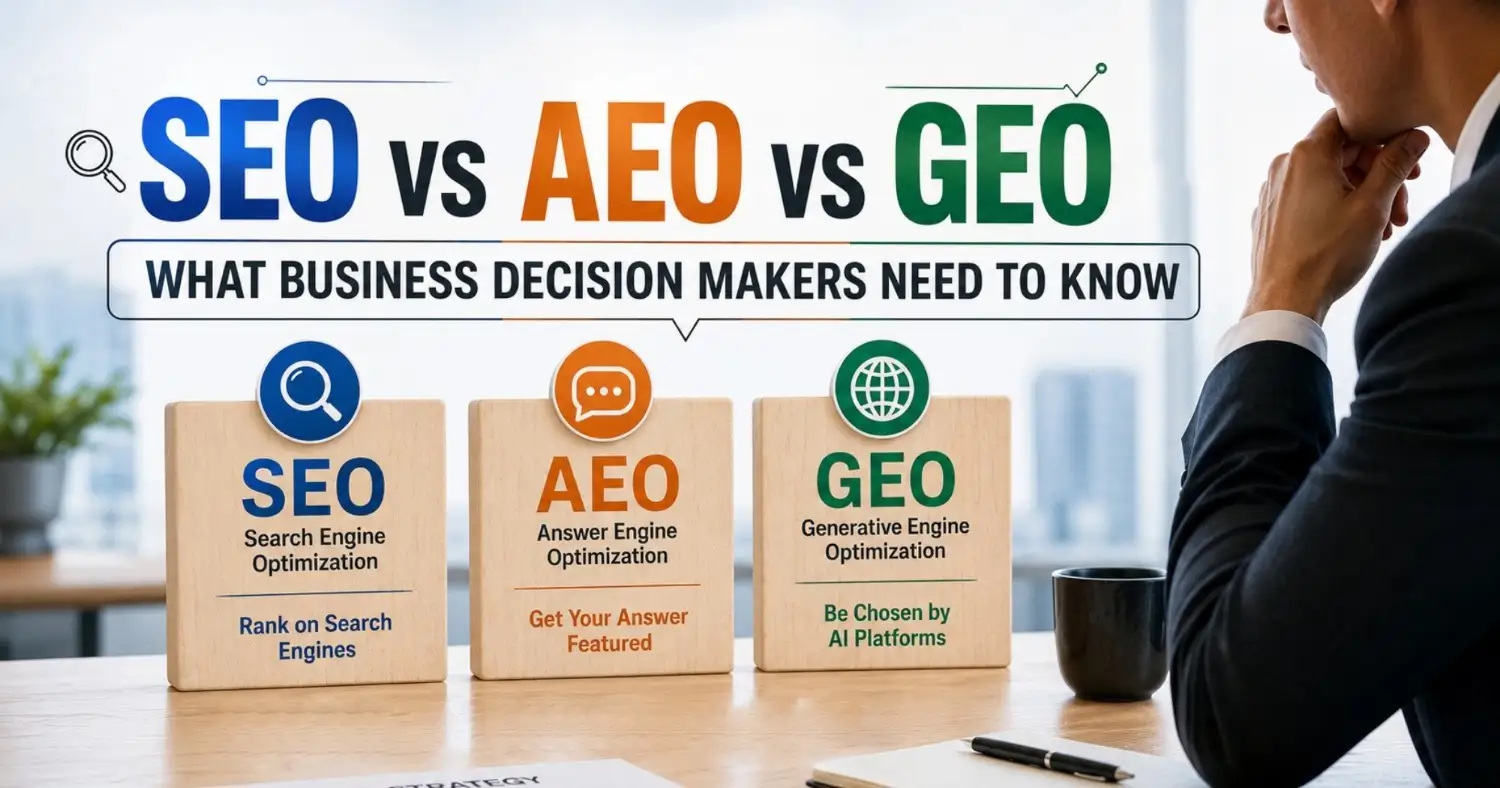
- SEO Metrics: This model attracts visitors using the process of keyword ranking and backlinking. It records click-throughs that happen directly from a regular search engine results page.
- The Rise of Zero-Click Searches: Over 50% of online searches today conclude without leaving the results page itself. People are able to retrieve their information without needing to go to another site.
- Answer Engine Optimization (AEO): This is a targeted technique of presenting written information in order to earn featured snippets. It’s used to generate answers from voice assistants and other chatbots.
- Generative Engine Optimization (GEO): An advanced model created to provide material to language models. It ensures brand citations within AI-generated summaries.
- Funnel Growth: Company executives should combine all three of these techniques to remain visible. Today’s discovery channels have evolved into conversational interfaces.

Get a Quote

FAQ

Contact Us
Why This Shift Matters in 2026
Have you noticed that your search engine habits changed completely over the last few months? The traditional journey of clicking through a list of blue links is fading. People use tools like Perplexity or Gemini to get direct summaries instead of browsing individual websites.
Data shows that most searches now finish without a single user click. This means your enterprise can lose customers even if your website ranks at the top of old search results. A business needs a flexible model that handles these shifting discovery patterns. You must prepare your digital assets to feed traditional algorithms and generative engines simultaneously.
What Is SEO in the Modern Era?
Traditional search optimization remains the bedrock of your online presence. This process improves website visibility across standard search engine results pages. Through clean code and fast page speeds, it ensures that automated web crawlers can read your transactional pages. The main goal is to pull direct traffic to your landing pages.
When you invest in SEO Services, you build the baseline data structure that allows other optimizations to work. If your technical architecture is messy, automated bots cannot find your text to summarize it. Traditional optimization is necessary for buyers who want to look at exact pricing charts and read local case studies before choosing a provider.
Also Read: SEO Case Study: From Low Traffic to High Organic Visibility
What Is AEO and How Does It Capture Zero-Click Searches?
Answer Engine Optimization is a highly targeted framework that makes your corporate data machine-readable. As voice queries expand, the main goal of an AEO Strategy is to capture the direct answer box in featured snippets. You are not trying to be one choice among many. Your text is formatted to be the single answer provided to the user.
To optimize for answer engines, you must drop long introductions and use an answer-first layout. Every information asset should feature clear headings that match real conversational questions. Follow these headers immediately with a concise sentence that delivers the core data point. This clear format allows systems to parse your text and use your brand as a direct source.
What Is GEO for B2B and Enterprise Brands?
Generative Engine Optimization is the newest layer of digital discovery, moving far beyond basic keyword match patterns. This discipline focuses on optimizing content so that AI-driven engines include your business in their compiled summaries. Unlike standard ranking frameworks, a GEO strategy for businesses values citation share and source authority.
AI platforms scan the web to find facts and deep industry data. To win citations inside these systems, your text must feature high information density and verified data. Your brand must stand out as an undeniable authority that cannot be ignored by an algorithm. As digital systems change, your data must remain highly structured and easy to reference.
Also Read: The Role of AI in Digital Marketing Services
Quick Comparison: Structural Breakdown of SEO vs AEO vs GEO
SEO | AEO | GEO |
Focused solely on raising your website’s ranking on traditional search engine results pages. | Made for providing quick, direct answers to users’ questions. | This is to get your company mentioned as an official source of information in AI summaries |
The key advantage is generating real traffic to your site via clicks on your links. | Reads out loud your copy using voice assistants or smart speakers. | AI chatbots and language models embed your company name in their response, hence, generating trust. |
This works within the regular search engines of typical browsers. | Does well in audio interfaces and highlighted response panels. | Works directly inside conversational chat engines and large language models. |
You achieve this by targeting specific search terms and fixing your page tags. | Write simple, conversational Q&A blocks that fix a single problem fast. | Provide deep, info-heavy data sheets packed with original research and clean code tags. |
How Do You Integrate Search Optimization Strategies for Full-Funnel Growth
To protect your market share, you cannot view these three options as separate tactics. They function as interconnected pillars of a modern corporate marketing engine. A complete strategy uses specific actions at each point of the user journey to build a strong defensive barrier around your brand.
- The SEO Layer: This targets specific buyer terms by optimizing your service landing pages. It ensures that when a client is ready to finalize a vendor contract, your site is prepared to process that click.
- The AEO Layer: This captures research traffic by transforming your knowledge base into an authoritative asset. Using FAQ schemas allows your business to capture featured boxes before a buyer initiates a call.
- The GEO Layer: This builds long-term brand awareness across the web. By regularly publishing deep industry insights, you teach AI models to recognize your business name. This causes generative systems to recommend your company when users input conversational questions.
Why Should You Deploy Schema Markup Across All Three Pillars
Implementing advanced schema markup is an action that improves your standing across all platforms. Schema functions as a clear map of your website’s data. It ensures that crawlers and AI bots can interpret your business facts without getting lost in code. It removes confusion regarding your services, locations, and data points.
Traditional search engines use schema to generate eye-catching rich snippets that improve your organic click-through rates. Answer engines rely on this layout to extract data points for voice responses. Concurrently, generative engines scan these tags to verify facts before citing a brand in an output. For regional organizations, using deep LocalBusiness schemas is necessary for verifying service areas and physical addresses.
Executing Advanced Search Optimization with TreeMultisoft Services
Keeping track of how fast zero-click metrics and citation tracking are evolving is not an easy task for your company’s internal marketing team. It will take considerable expertise in data structuring and understanding the search algorithms’ inner workings in order to match your brand to these changing criteria. This is where TreeMultisoft Services comes into play.
We specialize in delivering advanced SEO Services that explicitly account for the operational requirements of AEO and GEO. Our team handles the difficult execution, from structuring dense thought leadership content to configuring clean schema frameworks across your digital properties. By partnering with TreeMultisoft, you remove the guesswork from your digital strategy and ensure your business is consistently found, answered, and cited wherever your clients are searching.
What Steps Must You Take to Align Your Brand for the Future of Discovery
The digital discovery environment is evolving permanently into an integrated AI model. Business owners who do not go beyond conventional keyword ranking strategies will find their visibility threatened by the advent of conversation-based search engines among customers. Your content has to be clear, concise, authoritative, and structured in such a way that it can be machine-read.
TreeMultisoft Services is always here cutting-edge search optimization strategies that will never let you feel lost in the world that’s changing its dynamics rapidly. We enable you to derive value from each channel in existence. We conduct a market analysis of your data with an unbiased eye in order to formulate a solid plan that helps generate traffic on your website as well as citations by AI programs.
Get a Quote
FAQ
Contact Us
FAQs
Q1.Why is an AI-driven content strategy crucial for businesses in 2026?
A1: With over 60% of searches resulting in no clicks, traditional website traffic patterns are declining. An advanced content strategy ensures your insights are formatted correctly for AI overviews and large language models, allowing your brand to remain highly visible even when users do not click through to a traditional website.
Q2. How do GEO and AEO differ from traditional SEO?
A2: Traditional search optimization focuses on driving direct user clicks to a website via keyword relevancy and link metrics. AEO is a surgical approach designed to capture direct answer boxes and voice search outputs. GEO focuses on structuring data so that generative AI engines easily synthesize and cite your brand inside their conversational summaries.
Q3. What role does schema markup play in modern search optimization strategies?
A3: Schema markup provides a direct, machine-readable map of your website data for automated crawlers and AI bots. It helps traditional search engines generate rich snippets, allows answer engines to pull rapid voice snippets, and helps generative models verify the structural facts they cite in their answers.
Q4 .How does TreeMultisoft assist companies adapting to these technical changes?
A4: TreeMultisoft provides end-to-end technical optimization, including deep semantic mapping, schema implementation, and high-density content creation. We structure your digital properties so that your corporate data is easily recognized and prioritized by both traditional search algorithms and generative AI models.
Q5.How fast can I expect to see results from my paid campaigns?
A5:Paid advertising provides the fastest results in digital marketing. Your ads can go live and start driving targeted traffic to your landing page within hours of setting up your account. This makes it an ideal strategy for launching new products or capturing urgent local leads.